
2Q26 Letter: A New Chapter
The launch of Telos Partners marks an exciting new chapter for our firm. We also review the resilient U.S. economy, the AI investment boom, and why disciplined asset allocation remains the foundation of long-term investing.
Business Update
The second quarter marked an important milestone for both of our firms.
After years of building Evolve Investing and Forrest Financial Partners independently, we officially brought our practices together under a new firm: Telos Partners.
While the name is new, the work behind it is not.
Both firms were built around a shared belief that wealth management should extend well beyond investment portfolios. Increasingly, our conversations with clients revolve around taxes, estate planning, charitable giving, liquidity events, business transitions, and helping families make thoughtful financial decisions through life's biggest moments.
Telos is a Greek word meaning purpose or ultimate aim. We chose it because we believe wealth is not an end in itself. It is a resource that can provide security, create opportunity, support generosity, and help people live with greater intention.
That philosophy sits at the center of everything we do.
We're also excited to welcome Nick Stecklein, CFP®, EA, as our Tax Advisor. Bringing tax expertise in-house allows us to integrate investment management, financial planning, and tax strategy much more closely than before. The result is more coordinated advice, fewer moving pieces, and better outcomes for clients with increasingly complex financial lives.
We're incredibly grateful for the trust you've placed in us over the years. While this quarter represents the beginning of a new chapter, it also reflects the values that have guided both firms from the beginning. We couldn't be more excited about what's ahead.
Questions We’re Hearing
One of the quiet privileges of this work is the range of conversations we have each quarter. When we look back at the second quarter, a few themes came up again and again across very different households.
AI was on almost everyone's mind. The questions fell into two camps. Some of you asked whether this looks like a bubble and whether we should be trimming exposure. Others asked the more personal version: what does this mean for my industry, my company, my job? Both are the right questions to be asking, and we are watching the same signals you are. Our view is that the answer is not to guess the top, but to own great businesses at sensible weights and to stay diversified enough that no single narrative can define your outcome.
Many of you feel the market is "too good." More than a few clients told us some version of "I keep waiting for the other shoe to drop." That instinct is healthy, and it is also why we build plans that are meant to survive a downturn rather than depend on avoiding one. The cost of sitting in cash waiting for a correction has historically been far higher than the corrections themselves.
The world felt loud, and the market shrugged. Several of you noted how strange it was to watch markets climb through real geopolitical tension this spring. It is a good reminder that markets and headlines run on different clocks, and that reacting to the news is rarely the same as investing.
We do not have a crystal ball, and we will never pretend to. What we can promise is that your plan is built to hold up across a range of outcomes, not a single forecast. If any of these themes are weighing on you, that is exactly what your next review is for.
Strong Fundamentals, Measured Optimism
Financial markets continued to surprise investors during the second quarter. Despite geopolitical tensions, elevated inflation, and interest rates that remain well above pre-pandemic levels, equity markets continued climbing to new highs.
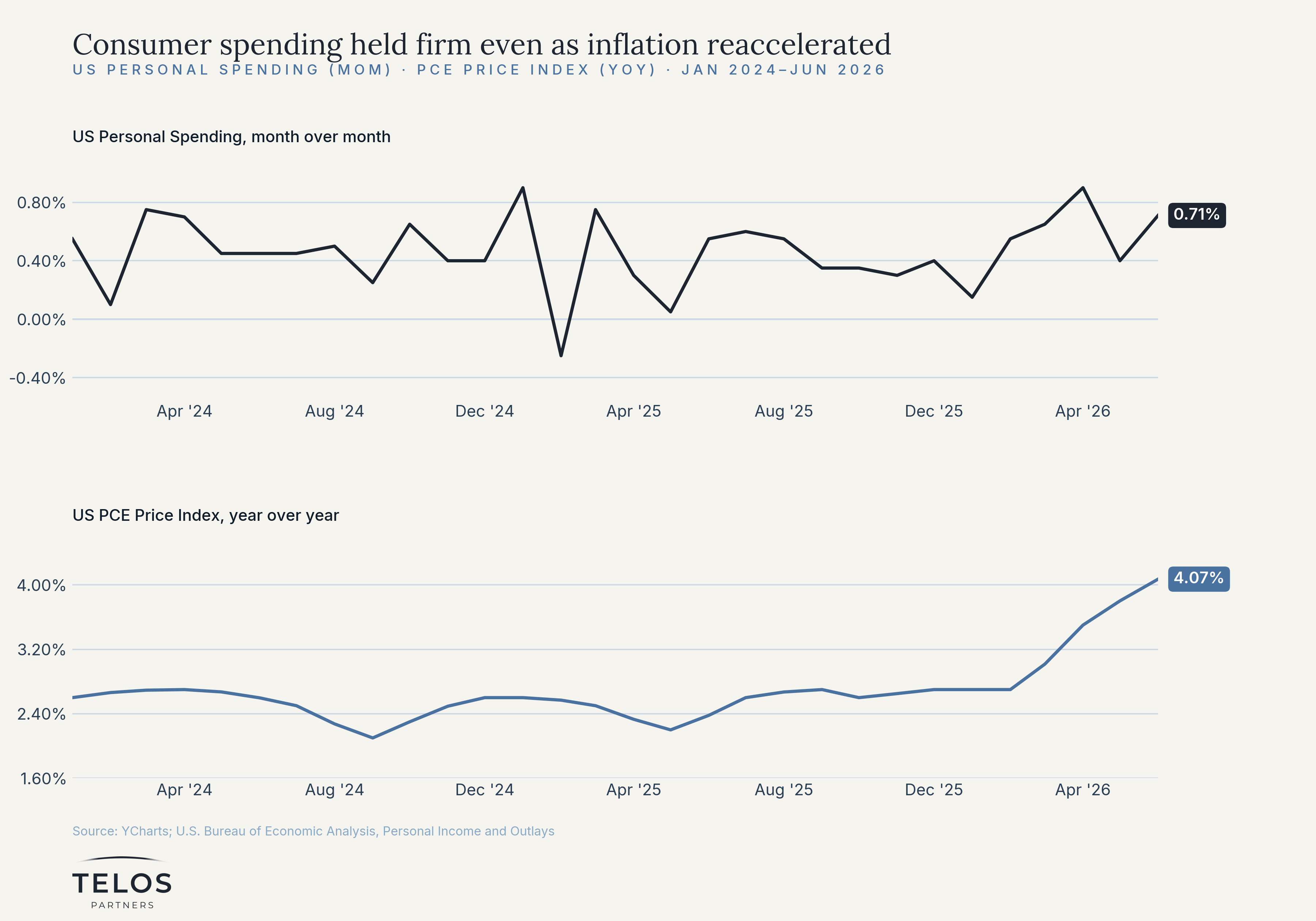
Much of that resilience has come from a surprisingly strong U.S. economy. Consumer spending, which accounts for roughly two thirds of US economic output, has remained healthy. In May, the personal consumption expenditures index rose 4.1% year-over-year, while core PCE, which excludes food and energy, increased 3.4%. These numbers suggest households are continuing to spend through the economic fallout from the Iran war.
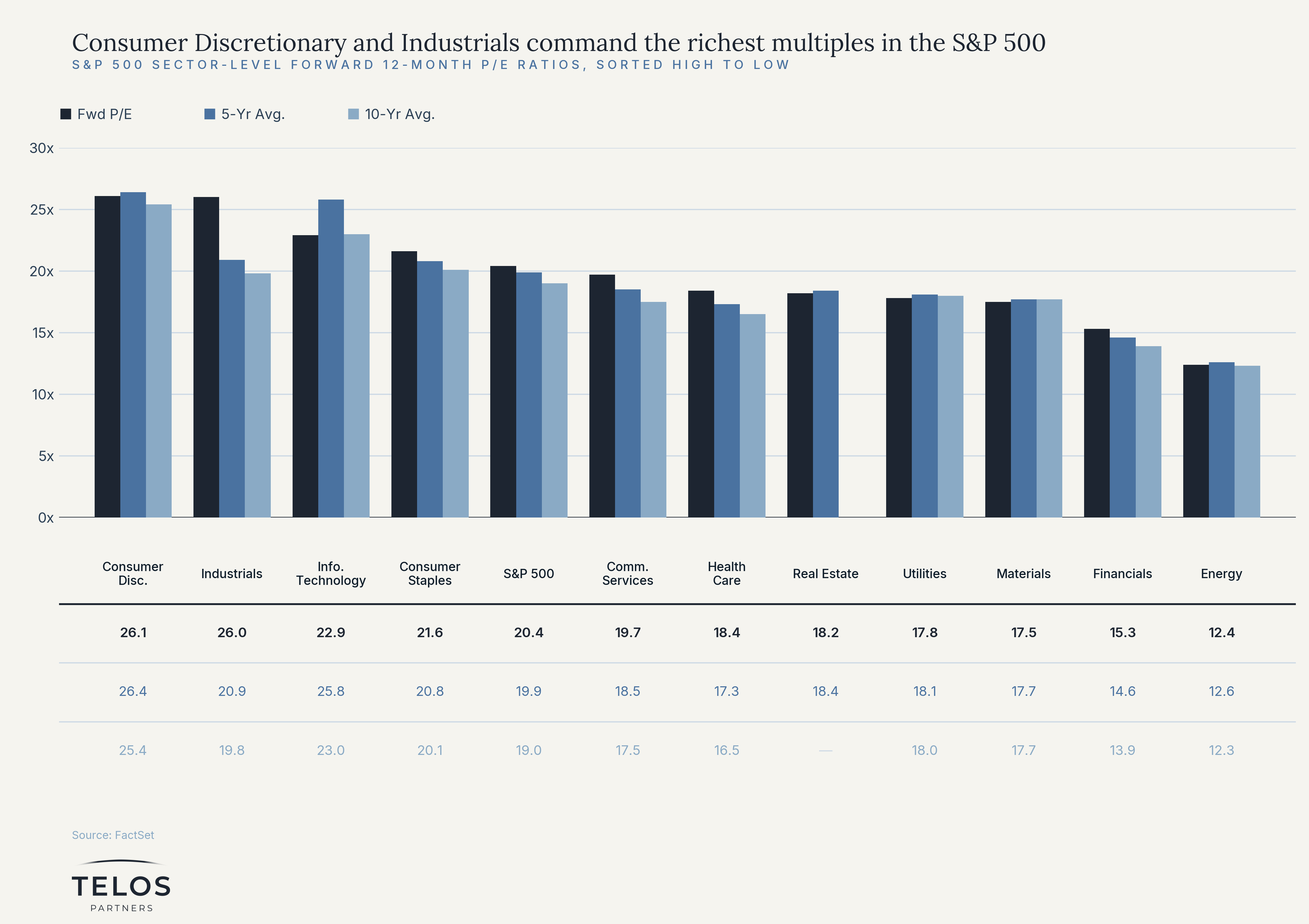
What is notable about the market’s run is that there is earnings growth behind it. Valuations are elevated, but not dramatically disconnected from longer-term averages. The S&P 500 trades at roughly 20.4x forward earnings, compared with a five-year average of 19.9x and a ten-year average of 19.0x.
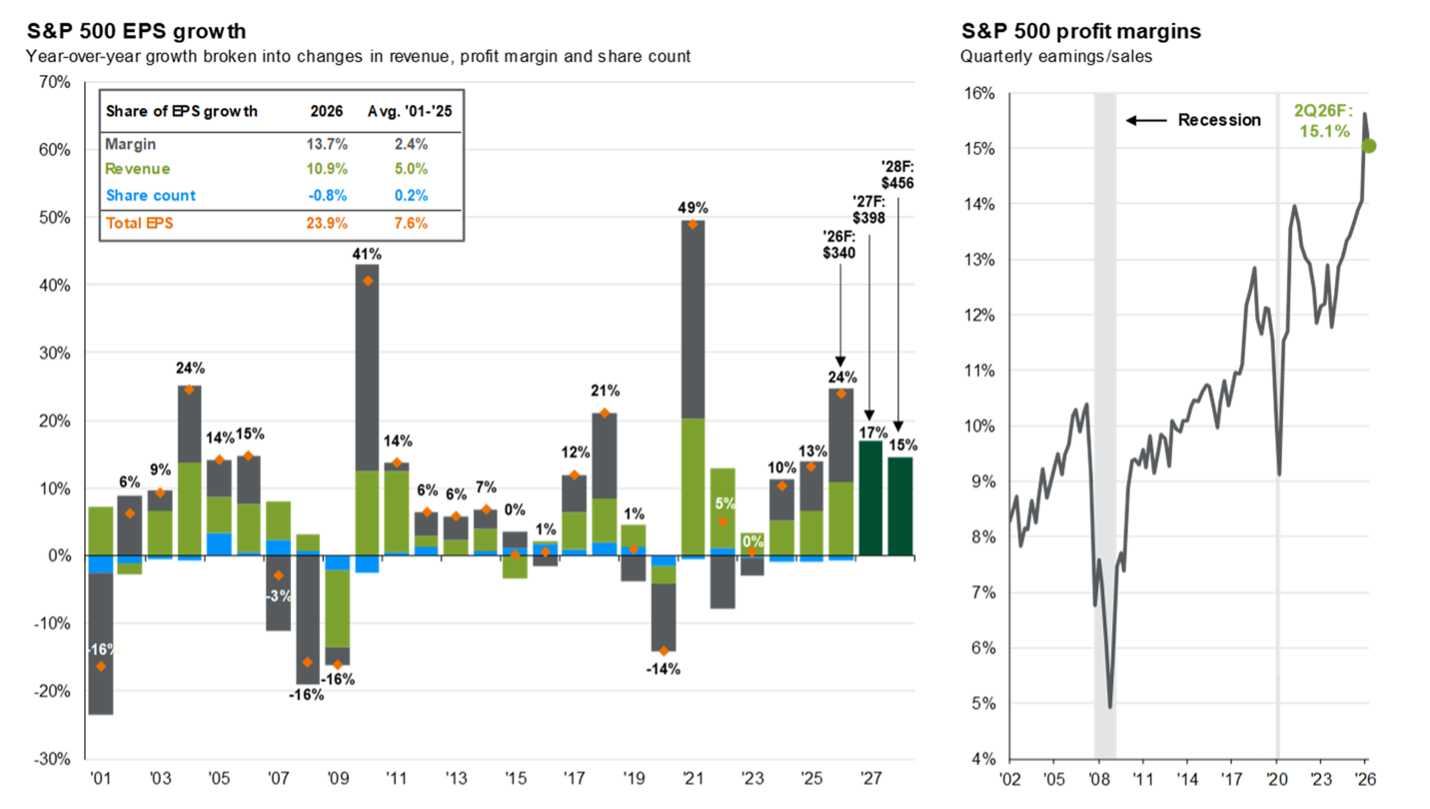
At the same time, earnings expectations have improved meaningfully. During the second quarter, bottom-up EPS estimates rose at the fastest pace since 2021, and positive guidance broadened, particularly in technology, semiconductors, and software. In short, the market is not cheap, but fundamentals have delivered enough to justify much of the move, in our view.
Profit margins have also been a key contributor. As shown in the J.P. Morgan chart below, expanding margins have played an important role in supporting earnings growth, helping explain why equities have continued to climb despite inflation, higher rates, and geopolitical uncertainty.
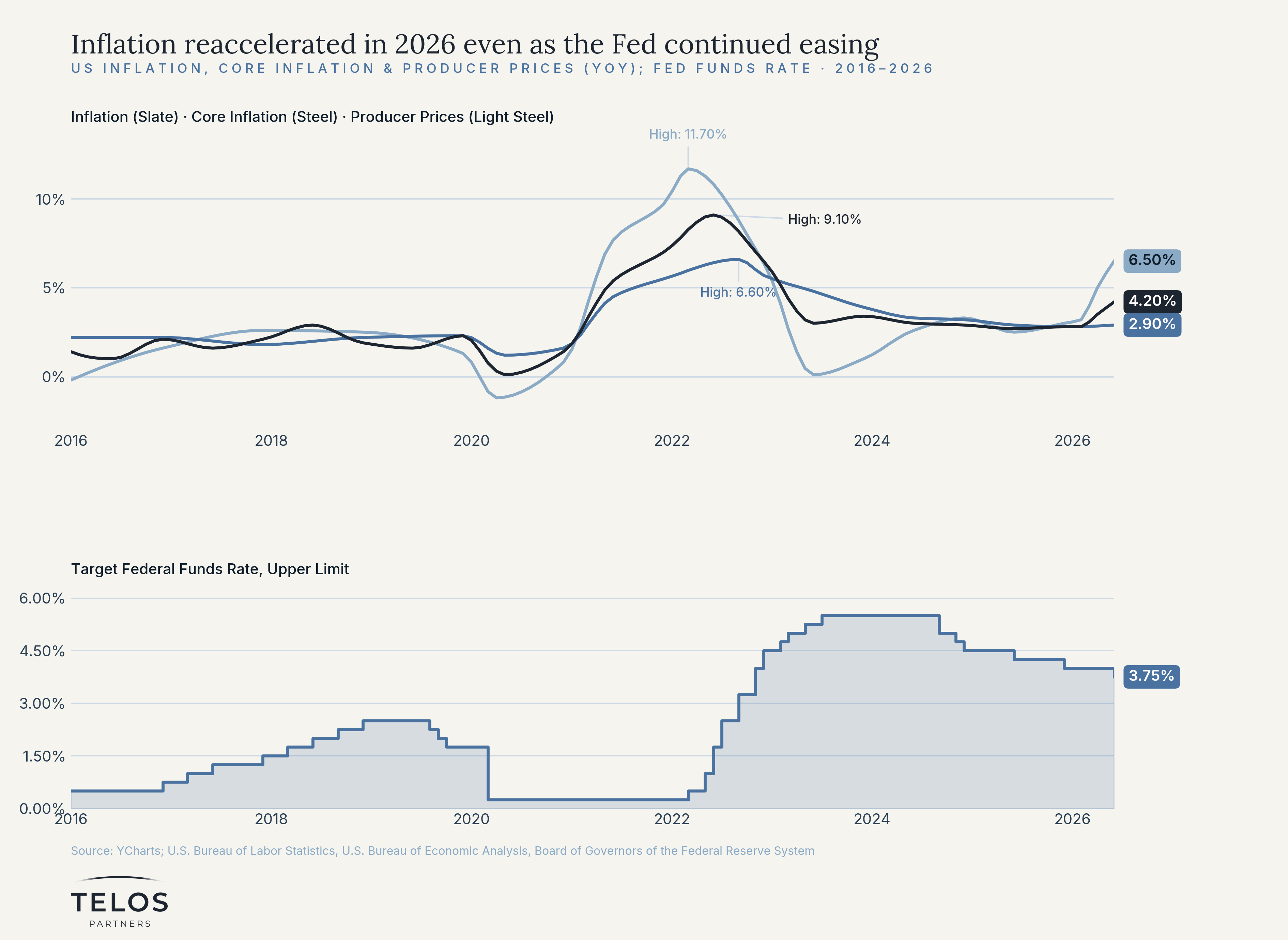
Inflation, however, remains the market's primary challenge, in our view. Higher energy prices pushed headline inflation higher during the quarter amid the stronger consumer spending environment, causing the Federal Reserve to remain cautious about lowering interest rates. While many economists still expect inflation to moderate over time, the path is likely to remain uneven, reinforcing the importance of maintaining diversified portfolios rather than trying to predict every policy decision.
Deep Dive: AI, Investment Booms, and Bubbles
No investment theme has generated more excitement - or more debate - than artificial intelligence.
Hardly a week goes by without another announcement of tens or even hundreds of billions of dollars being committed toward new chips, data centers, or AI infrastructure. Just last week, Samsung and SK Hynix announced plans to invest more than $500 billion into a new semiconductor hub. Shortly afterward, semiconductor stocks rallied sharply.
This spending is creating a powerful tailwind across much more than technology. Semiconductor manufacturers, utilities, electrical equipment companies, industrial firms, engineering businesses, and even construction suppliers are benefiting from one of the largest capital spending cycles in decades.
Some estimates suggest AI-related investment could add roughly 1.5 percentage points to U.S. GDP growth over the next two years, a contribution comparable to the business investment boom during the late 1990s technology cycle. Whether those investments ultimately generate attractive long-term returns remains one of the biggest questions facing investors today.

Naturally, not everyone shares the market's enthusiasm.
Michael Burry, best known for anticipating the housing crisis nearly two decades ago, recently expanded several of his bearish positions against AI-related companies and semiconductor investments. His concern isn't that AI won't change the world. Rather, it's that investors may be extrapolating today's extraordinary capital spending too far into the future before knowing whether those investments will ultimately generate sufficient returns.
We think that's an important distinction.
History shows that transformative technologies often move through periods of excessive optimism. Railroads, automobiles, electricity, and the internet all fundamentally reshaped society, while also producing investment bubbles along the way. In each case, the bubbles eventually burst, but the underlying technologies continued transforming the economy for decades afterward.
We believe AI is likely to follow a similar long-term path.
The technology itself appears genuinely transformative, and we believe AI may ultimately prove every bit as important as the internet. At the same time, history reminds us that revolutionary technologies can create enormous value for society while also producing periods of overexuberance in financial markets.
Going forward, we are closely monitoring whether AI-related capital spending continues translating into durable revenue growth, margin expansion, and free cash flow. We are also watching the breadth of market leadership, the sustainability of earnings growth beyond the largest technology companies, and whether valuations remain supported by fundamentals rather than enthusiasm alone.
Our base case remains constructive: we believe AI is a genuinely transformative technology, and we believe today’s valuations are reasonable. But as with any major investment theme, discipline matters. We will continue to distinguish between businesses with durable competitive advantages and cash-generating economics, and those whose valuations depend more heavily on promise than proof.
Why Asset Allocation Still Matters
If there's one lesson we've learned over decades of investing, it's that markets will always find new reasons to make investors either overly optimistic or overly pessimistic.
This quarter those reasons included inflation, geopolitical conflict, Federal Reserve policy, AI spending, and concerns over whether today's leaders can justify tomorrow's expectations.
None of those headlines changed our investment philosophy.
Equities may be headed for a fourth consecutive year of double-digit returns, something we have not seen since the 1990s. At the same time, core bonds have lagged cash so far this year.
Even so, bonds still play an important role in portfolios. Their purpose is not simply to maximize return in every environment, but to reduce volatility and help portfolios recover more quickly after equity drawdowns. Since 1988, stocks have taken an average of roughly 24 months to recover from a 20% decline, while a traditional 60/40 portfolio has recovered in about half that time.
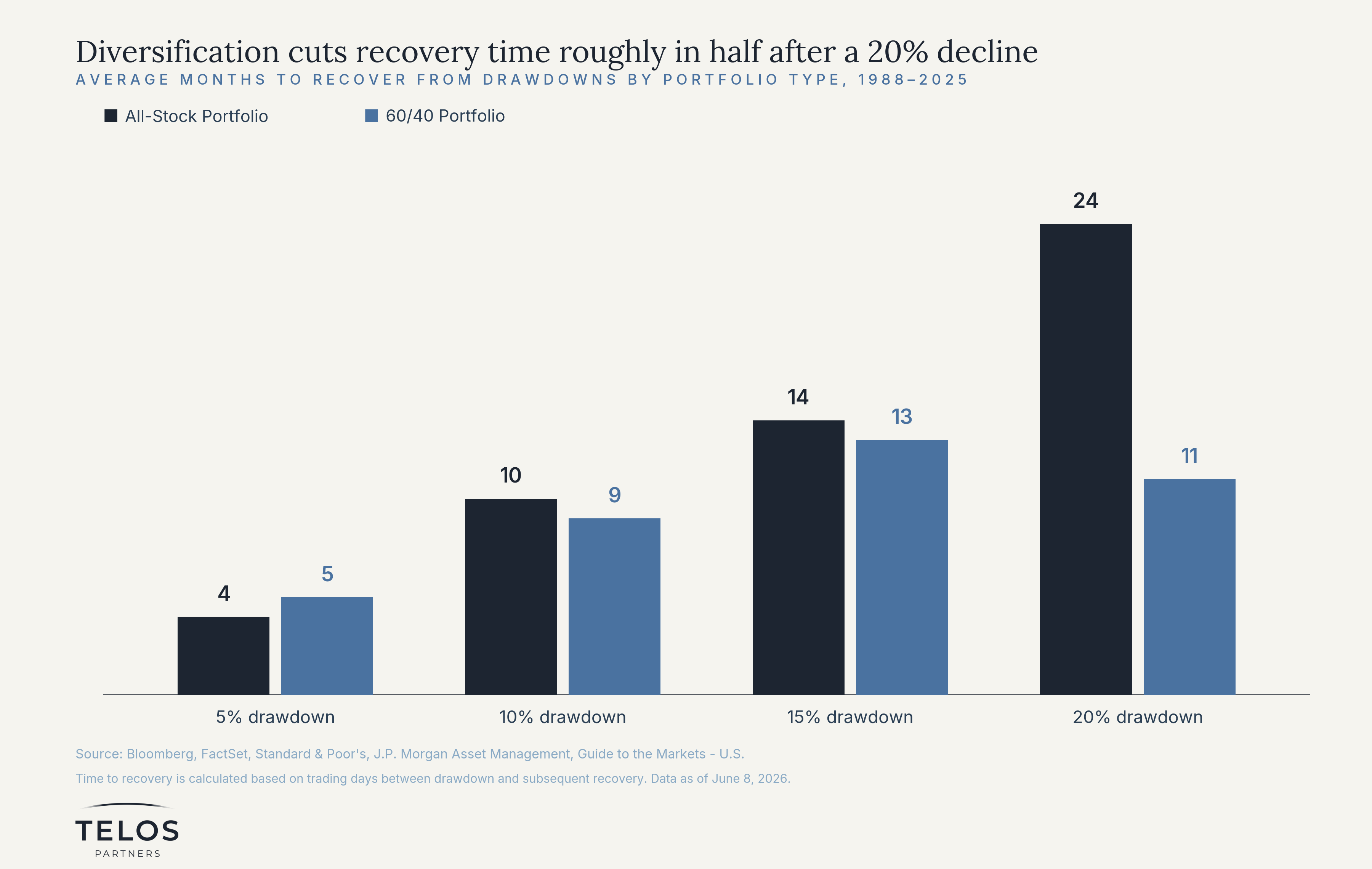
Our clients continue to hold diversified portfolios built around long-term objectives rather than short-term predictions. Strategic asset allocation remains one of the few investment decisions we can control. History suggests it continues to matter far more than attempting to time the next headline.
Looking Ahead
As we enter the second half of 2026, we remain optimistic but realistic.
The economy continues to show resilience. Corporate earnings remain healthy. AI investment is creating meaningful opportunities while simultaneously raising important questions about valuation. Inflation appears likely to moderate over time, though probably not in a straight line.
Our focus is unchanged.
We'll continue helping clients make thoughtful decisions around investing, taxes, estate planning, charitable giving, and the many financial choices that accompany increasingly complex lives.
If you'd like to discuss your portfolio, your financial plan, or simply catch up after the transition to Telos, please don't hesitate to reach out.
As always, thank you for your continued trust and partnership.
Best,
Peter Hughes, CFA, CPWA®
Founding Partner
Chris Stevenson, CFA
Founding Partner
Related Articles

3Q26 Letter: Resilience, Rates, and a Growing Telos
Lorem ipsum dolor sit amet, consectetur adipiscing elit. Suspendisse varius enim in eros elementum tristique. Duis cursus, mi quis viverra ornare, eros dolor interdum nulla, ut commodo diam libero vitae erat. Aenean faucibus nibh et justo cursus id rutrum lorem imperdiet. Nunc ut sem vitae risus tristique posuere.

3Q25 Letter: Markets Rally, AI in Focus
Lorem ipsum dolor sit amet, consectetur adipiscing elit. Suspendisse varius enim in eros elementum tristique. Duis cursus, mi quis viverra ornare, eros dolor interdum nulla, ut commodo diam libero vitae erat. Aenean faucibus nibh et justo cursus id rutrum lorem imperdiet. Nunc ut sem vitae risus tristique posuere.