
Is 2026 Looking More Like 2018?
The recent market sell-off may have more in common with late 2018 than the dot-com bubble. With a stronger earnings outlook, substantially lower technology valuations, and the possibility of a less hawkish Federal Reserve than markets anticipate, I explore why investors should be considering the upside risks as carefully as the downside risks.
Is 2026 Looking More Like 2018?
In my note earlier this week, I discussed the recent sell-off, the extraordinary compression in technology valuations, and why I find parts of the equity market increasingly attractive.
While much of the commentary surrounding the AI trade has drawn comparisons to the dot-com bubble, I think the fourth quarter of 2018 warrants a closer look.
Revisiting 2018
By late 2018, the Federal Reserve had been raising interest rates for several years. Tightening financial conditions, trade tensions, and concerns about slowing global growth drove the S&P 500 nearly 20% below its September high.
Then, in early January 2019, Jerome Powell signaled that the Fed was prepared to be patient. Bond yields declined, financial conditions eased, and the S&P 500 went on to deliver a total return of approximately 31% in 2019.
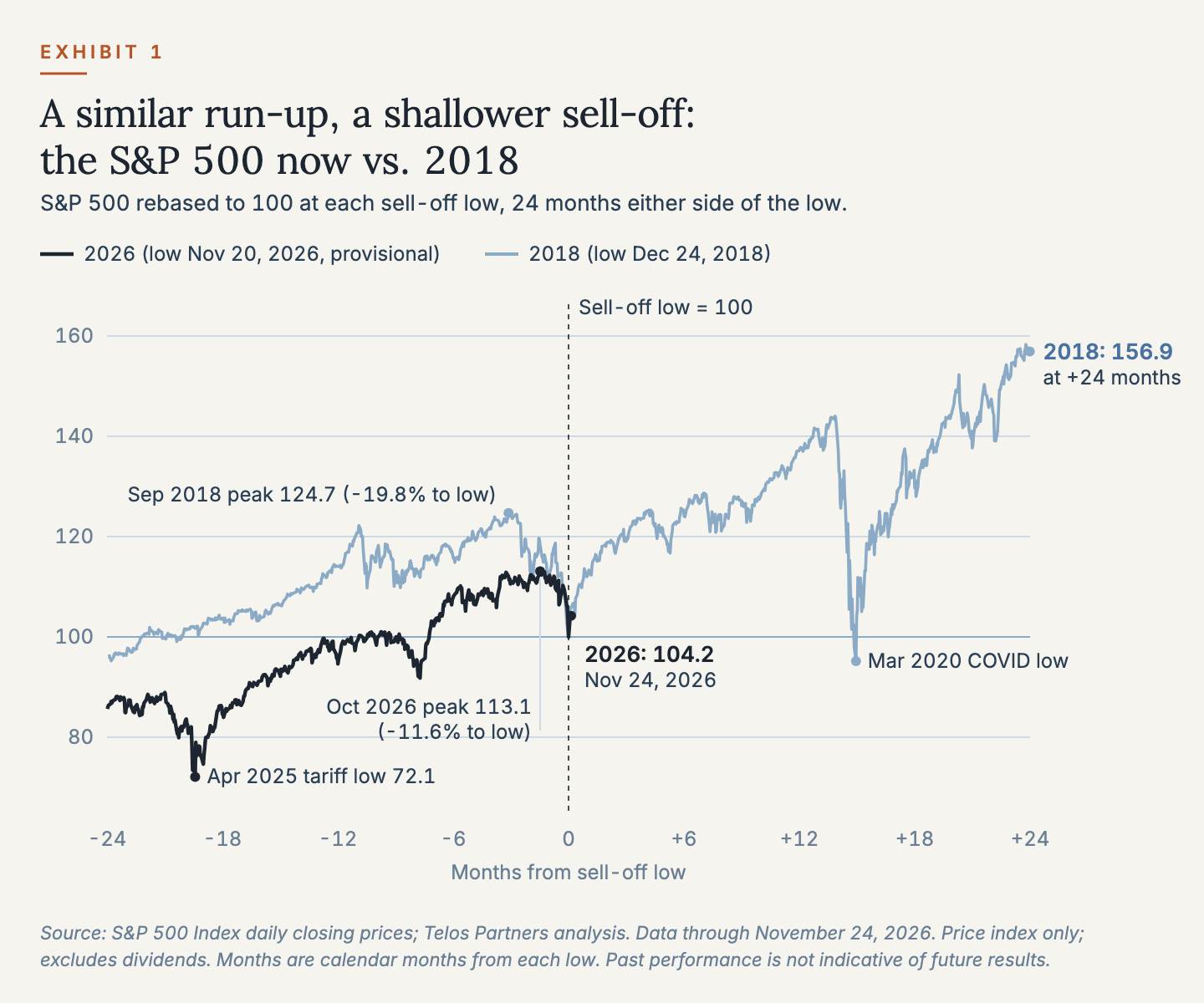
What makes that recovery particularly interesting is that corporate earnings were essentially flat in 2019. Investors didn't need an acceleration in economic growth to generate extraordinary returns. A shift in monetary policy and the resulting expansion in valuation multiples proved sufficient.
A Potentially Stronger Earnings Backdrop
There are some important parallels today. Inflation concerns have renewed expectations of monetary tightening, and higher interest rate expectations have contributed to a substantial repricing of equities.
But there is also an important difference: the earnings outlook.
FactSet's consensus estimates point to S&P 500 earnings growth of 16.4% in 2027, alongside revenue growth of 10%. Even if those estimates prove somewhat optimistic, earnings growth could remain considerably above its historical annual rate of 6% to 7%.
Meanwhile, technology stocks are trading at a discount to the broader market on a forward earnings basis, a striking contrast to the premium they commanded during the dot-com bubble.
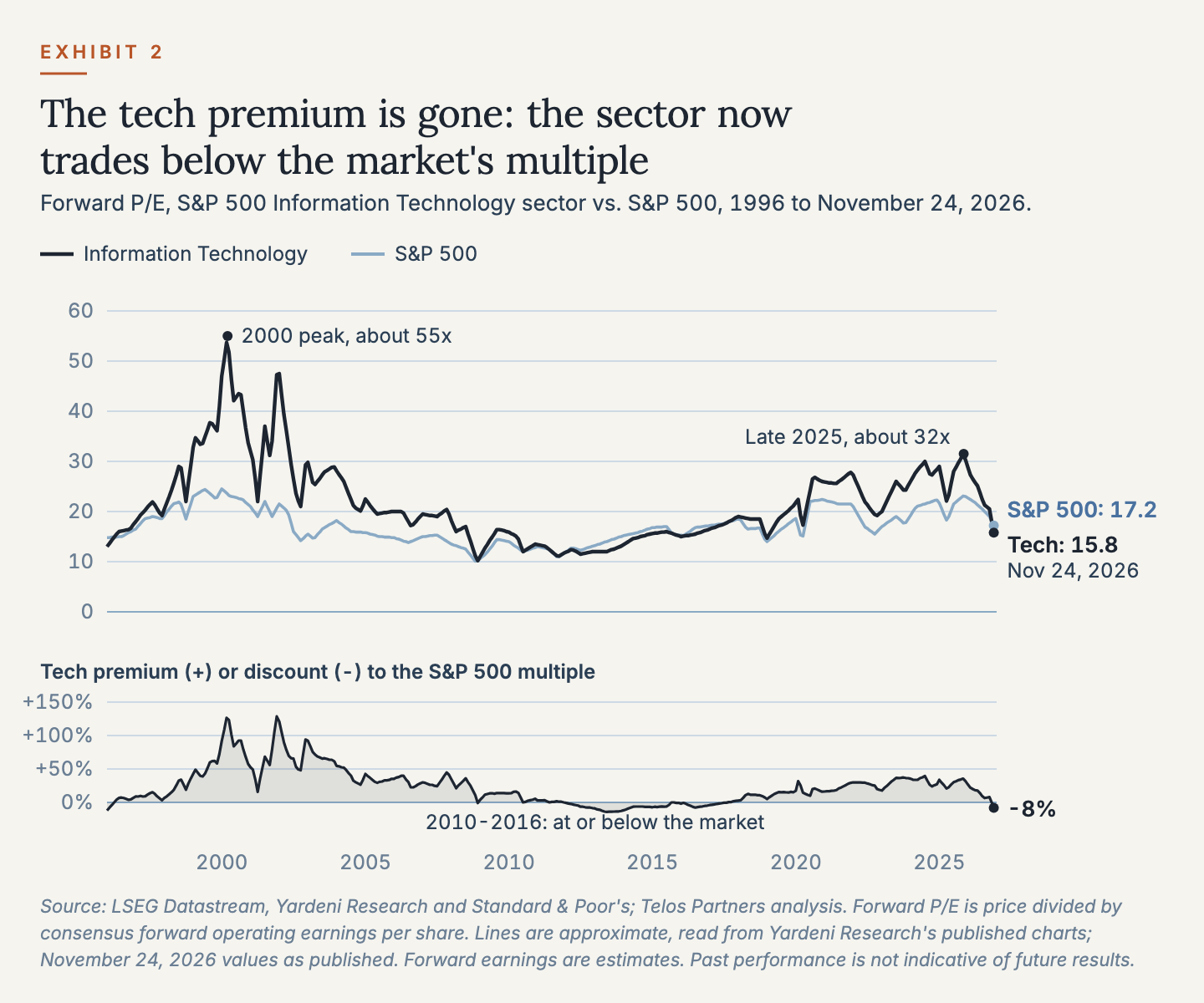
Investors are being offered the opportunity to participate in unusually strong earnings growth at a meaningful discount to what they were willing to pay just weeks ago.
Is the Market Too Pessimistic About the Fed?
What I find interesting is that the market appears to be pricing in two economic narratives that are somewhat at odds with one another: a meaningful slowdown in AI investment and an increasingly aggressive Federal Reserve.
If the AI investment cycle slows materially, the resulting weakness in capital expenditures, economic growth, and demand should, all else equal, alleviate some inflationary pressure and reduce the need for monetary tightening.
Conversely, if economic growth remains sufficiently robust to warrant further rate increases, that may also be consistent with a more resilient corporate earnings environment.
Neither outcome is necessarily bad for equities at today's valuations. The more challenging scenario would be one in which growth deteriorates while inflation remains stubbornly high.
I also think it's worth distinguishing between the Fed raising interest rates and the Fed raising rates more aggressively than markets already anticipate. It is the latter that matters most for valuations. The December meeting could prove important, not because the Fed needs to reverse course, but because it may simply need to be less hawkish than investors expect.
Considering the Upside
Unlike in 2019, a recovery in equity prices today could be supported by both meaningful earnings growth and an expansion in valuation multiples.
That is not a prediction, nor does it require a particularly optimistic view of the economy. It requires corporate earnings to remain reasonably resilient and monetary policy to prove less restrictive than markets currently anticipate.
The recent correction has removed much of the optimism previously embedded in technology valuations. I think it's increasingly important to consider the upside risks as carefully as we consider the downside risks.
Much of the prevailing narrative has focused on what could go wrong. At today's valuations, I find myself increasingly interested in what happens if things go reasonably well.
Best,
Peter Hughes, CFA, CPWA®
Founding Partner
Telos Partners
Related Articles

On Market Efficiency, Valuation, and the Recent Selloff
Lorem ipsum dolor sit amet, consectetur adipiscing elit. Suspendisse varius enim in eros elementum tristique. Duis cursus, mi quis viverra ornare, eros dolor interdum nulla, ut commodo diam libero vitae erat. Aenean faucibus nibh et justo cursus id rutrum lorem imperdiet. Nunc ut sem vitae risus tristique posuere.

3Q26 Letter: Resilience, Rates, and a Growing Telos
Lorem ipsum dolor sit amet, consectetur adipiscing elit. Suspendisse varius enim in eros elementum tristique. Duis cursus, mi quis viverra ornare, eros dolor interdum nulla, ut commodo diam libero vitae erat. Aenean faucibus nibh et justo cursus id rutrum lorem imperdiet. Nunc ut sem vitae risus tristique posuere.