
On Market Efficiency, Valuation, and the Recent Sell-off
Why fundamental analysis and efficient markets aren't at odds, and what the recent sell-off does and doesn't tell investors.
Dear Clients and Friends,
I started managing institutional money 23 years ago. Since then, I've invested through several market cycles, including the aftermath of the dot-com bubble, the global financial crisis, the long bull market that followed, the pandemic, and now the extraordinary investment cycle surrounding artificial intelligence.
Throughout my career, I've considered myself a fundamental analyst. I believe the value of a business is ultimately determined by its ability to generate cash flows for shareholders, and that the price we pay for those cash flows matters.
At the same time, I've always believed in the efficient market hypothesis: the idea that security prices generally reflect available information, making it exceedingly difficult to consistently outperform markets through superior forecasting or market timing.
These beliefs might seem contradictory. If markets are efficient, why study valuations? And if valuations matter, shouldn't we be able to identify when markets are overvalued and position portfolios accordingly?
I don't think the two are mutually exclusive.
Markets are remarkably good at incorporating information into prices. But those prices reflect expectations about an uncertain future, and expectations can change dramatically. Fundamental analysis helps us understand what investors are paying for, the assumptions embedded in valuations, and whether prospective returns adequately compensate us for the risks involved.
What it cannot reliably tell us is where the market will trade next week, next month, or even next year.
I think that distinction is particularly relevant today.
What the Recent Selloff Tells Us
Over the past six weeks, equity markets have experienced one of their sharpest corrections in recent years.
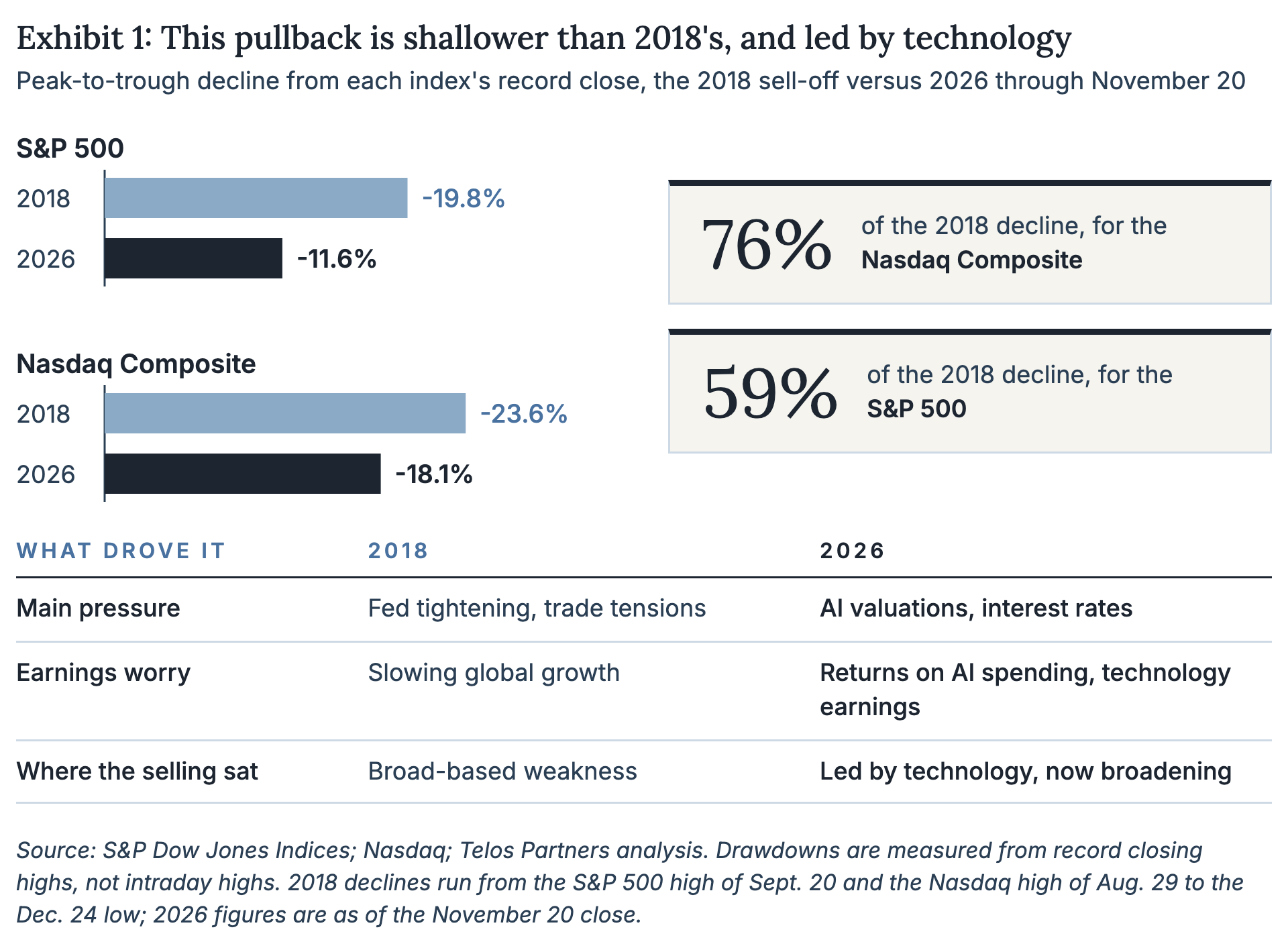
Through November 20, the S&P 500 had declined 11.6% from its October 6 closing high, while the Nasdaq Composite had fallen approximately 18%. Several prominent technology companies have suffered considerably larger declines, some losing 40% to 60% of their market value.
The magnitude of these losses invites comparisons to both the fourth quarter of 2018 and the bursting of the dot-com bubble in 2000.
In 2018, the S&P 500 declined nearly 20% amid concerns about rising interest rates, trade tensions, and slowing economic growth. The economy avoided recession, the Federal Reserve eventually reversed course, and equities recovered.
The dot-com collapse was considerably more prolonged. Many technology companies suffered extraordinary losses, and the correction eventually spread into the broader economy. The internet went on to transform nearly every industry, even as many of the companies that attracted enormous investor enthusiasm failed to generate attractive investment returns.
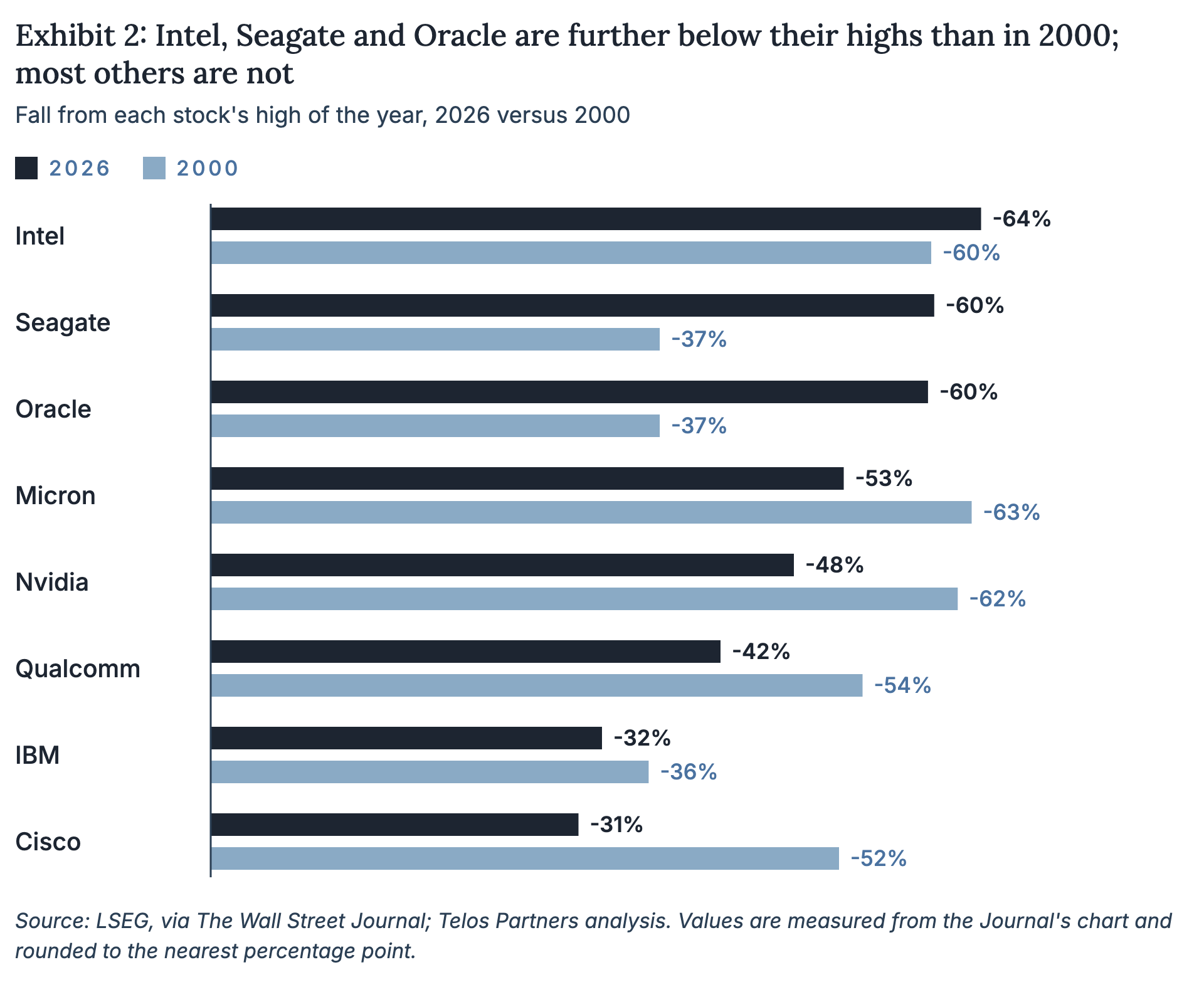
The lesson isn't that today's market must follow either path. It's that a transformative technology and an attractive investment are not necessarily the same thing.
Understanding Valuation and Opportunity
One of the more interesting developments during the current correction has been the extent to which technology valuations have declined, even as earnings have continued to grow.
From its recent peak above 30x, the S&P 500 technology sector's forward price-to-earnings multiple has contracted by more than 40%, reaching 16.6x as of November 20, according to Yardeni Research. This represents one of the most significant valuation resets in nearly three decades.
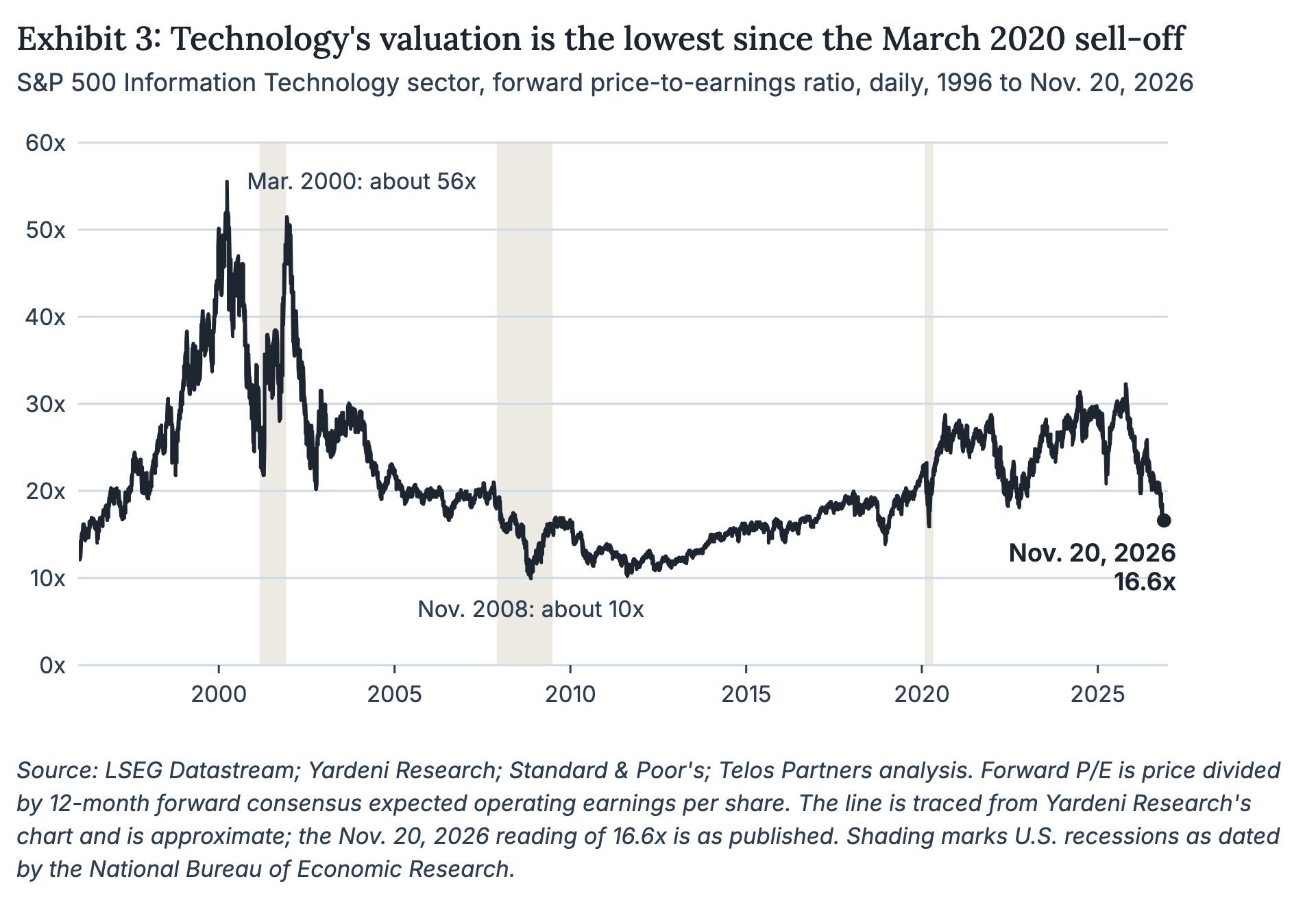
Companies benefiting from the AI investment cycle have, in many cases, continued reporting substantial revenue and earnings growth. Yet their share prices have declined because investors are no longer willing to pay the same premium for that growth. This doesn't necessarily mean the market was wrong before or is wrong today. It means the market is reassessing the future.
Nvidia provides a particularly interesting example. Despite extraordinary revenue and earnings growth, its shares have fallen sharply, leaving the company trading at approximately 8.9x forward earnings. That is a remarkably low multiple for a business growing at Nvidia's pace, particularly when compared with slower-growing companies commanding considerably higher valuations.
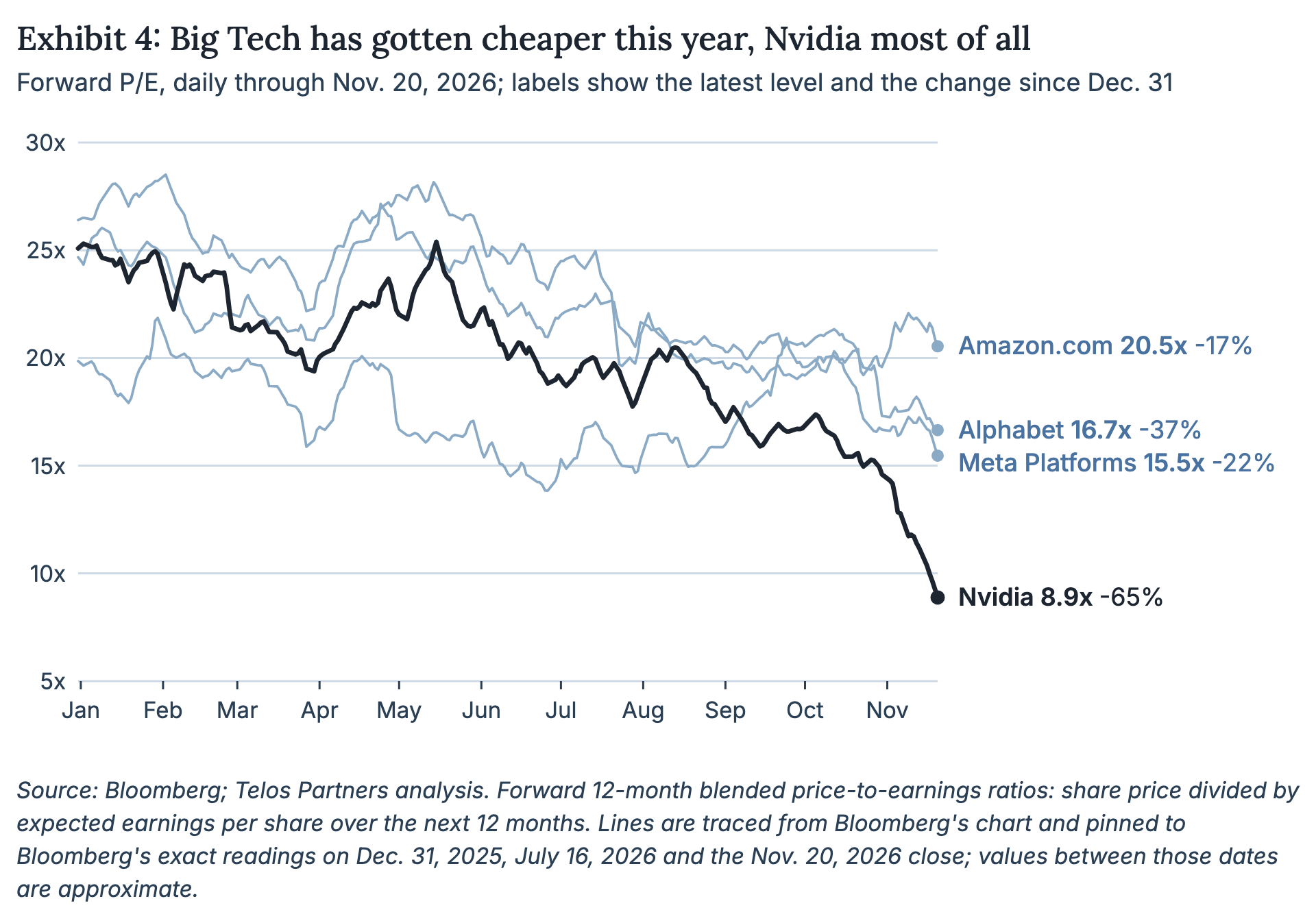
But Nvidia's valuation also reflects legitimate uncertainty about the durability of its business model. The company has enjoyed operating margins approaching 70%, substantially above those of traditional semiconductor businesses. Maintaining that profitability will become increasingly difficult as major customers develop their own chips, suppliers seek a greater share of the economics, and competition intensifies.
The company also faces uncertainty following Jensen Huang's departure, including whether his longstanding relationships with key partners such as TSMC can be preserved, as well as allegations involving its China business that could have lasting regulatory and commercial consequences.
The question isn't simply whether Nvidia is inexpensive relative to its historical valuation. It's whether its future earnings will justify today's price. If the company can sustain much of its competitive advantage, the recent decline may represent a compelling opportunity. If growth slows and margins normalize more rapidly than investors expect, even 8.9x forward earnings may prove less attractive than it appears.
So, Is This an Opportunity?
Markets are forward-looking. They don't wait for economic conditions to improve before recovering, just as they don't necessarily wait for earnings to deteriorate before declining.
I think the recent correction has improved prospective returns in parts of the equity market, particularly among profitable technology companies whose valuations have declined more rapidly than their earnings expectations.
Wall Street strategists project 2027 S&P 500 earnings per share of $408, up roughly 13% y/y and above historical averages of 6-7%. Unlike 2018, when investors were confronting slowing growth and tighter monetary policy, today's correction is occurring against a backdrop of unusually strong corporate profitability.

There are legitimate questions about the sustainability of AI investment and the pace of future earnings growth. But I remain constructive on the underlying fundamentals. The demand for computing power is real, and the companies leading this investment cycle are generating substantial cash flows. Earnings expectations may prove optimistic, particularly if AI investment moderates, but I don't see compelling evidence of an impending collapse in the economics of the industry.
What has changed considerably is the price investors are being asked to pay for that growth. With valuations having compressed so dramatically, I find parts of the technology sector increasingly attractive, even recognizing that prices could decline further. We don't need to identify the bottom to recognize that prospective returns have improved. All else equal, buying a business at 20 times earnings is more attractive than buying the same business at 30 times.
For investors holding excess cash intended for long-term investment, there is a reasonable case for putting some capital to work rather than waiting for an unmistakable signal that the correction has ended. By the time uncertainty passes, prices may already have adjusted.
For investors already fully invested in appropriately diversified portfolios, the conclusion may be less dramatic. There may be nothing that needs to be done.
Bringing It Back to Portfolio Construction
At Telos, our investment approach begins with understanding what each client's portfolio is intended to accomplish.
The appropriate allocation for a family drawing income from its investments differs from that of an investor with decades before retirement. Tax considerations, liquidity needs, concentrated holdings, and tolerance for volatility all influence how much risk a portfolio should assume.
Those considerations don't disappear because technology stocks have become less expensive.
We continue to believe that strategic asset allocation, diversification, tax efficiency, and disciplined rebalancing are among the most important decisions investors can make. Fundamental analysis informs how we allocate capital within that framework, but we don't build portfolios around the assumption that we can predict the next correction or recovery.
We build them to participate in long-term economic growth while remaining resilient through periods when the outlook is considerably less certain.
Our objective remains unchanged: to make thoughtful investment decisions, manage risk appropriately, and help our clients compound wealth over time without depending on our ability to predict the market's next move.
As always, please reach out if you'd like to discuss your portfolio or any of the themes above.
Best,
Peter Hughes, CFA, CPWA®
Founding Partner
Telos Partners
Related Articles

3Q26 Letter: Resilience, Rates, and a Growing Telos
Lorem ipsum dolor sit amet, consectetur adipiscing elit. Suspendisse varius enim in eros elementum tristique. Duis cursus, mi quis viverra ornare, eros dolor interdum nulla, ut commodo diam libero vitae erat. Aenean faucibus nibh et justo cursus id rutrum lorem imperdiet. Nunc ut sem vitae risus tristique posuere.

2Q26 Letter: A New Chapter
Lorem ipsum dolor sit amet, consectetur adipiscing elit. Suspendisse varius enim in eros elementum tristique. Duis cursus, mi quis viverra ornare, eros dolor interdum nulla, ut commodo diam libero vitae erat. Aenean faucibus nibh et justo cursus id rutrum lorem imperdiet. Nunc ut sem vitae risus tristique posuere.